


Farm Smart: Cashel Blue Cheese – Made, Matured, Graded & Selected in Co. Tipperary
Pat Morrissey has managed the herd at Cashel Blue Cheese in Co. Tipperary for over 35 years — and has relied on Herdwatch to keep calf registrations, medicine records, and Bord Bia compliance running smoothly the whole time.
Cashel Blue Cheese is one of Ireland’s most celebrated farmhouse products. It is made by hand on the same 200-acre farm in Co. Tipperary where it was first created — and the quality of the milk that goes into it is everything. That is why farm manager Pat Morrissey leaves nothing to chance.
Pat has managed the herd at Cashel Blue since 1988. Over that time, he has upgraded the herd to full pedigree and improved milk quality and volume. As a result, he has built a farm operation that underpins one of Ireland’s most recognised cheese brands. Herdwatch has been part of how he runs it for over a decade.
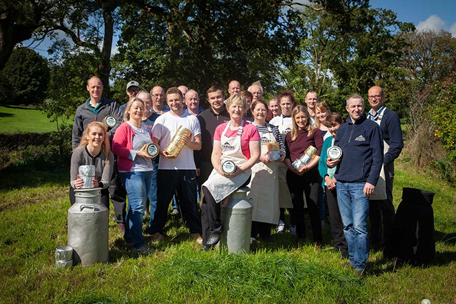
Behind the cheese: a 200-acre Tipperary dairy farm
Cashel Blue was created in 1984 by Jane and Louis Grubb at a time when softer blue cheeses were a rarity in the English-speaking world. Today, in the hands of the second generation — Jane and Louis’s daughter Sarah and her husband Sergio — it is still made entirely by hand on the same farm, employing over 38 people.
The farm and cheese operation work hand in hand. Around a third of the milk comes from the farm’s own pedigree Cashel Blue herd. Meanwhile, the remainder is sourced from local farms within a 25km radius. In addition, all milk must come from grass-fed cows during the growing season.
Pat’s herd — 35 years of continuous improvement
Cashel Blue’s herd runs around 140 pedigree Holstein Friesians on an all-year-round calving system. Pat breeds all his own replacements and keeps some bulls for sale, while also rearing surplus Friesian bull calves for weanling sale.
Around 80% of calving is in winter and 20% in spring — a deliberate decision to supply winter milk when volumes across the region are low. To support that, Pat invested in a new shed with fully automatic scrapers. Notably, the milking machine has not stopped a single day in 33 years.
Cell count is critical on a cheese farm. As a result, Pat monitors it closely and uses Herdwatch’s animal history and milk records to identify cows with persistent issues. Currently sitting around 60–70, he works to keep it as low as possible — and breeding decisions are made with that in mind.
How Pat found Herdwatch — and why he signed up on the spot
Pat first came across Herdwatch at the FRS stand at the National Ploughing Championships around 2014 or 2015. He describes himself as a “mature gentleman” who is not the most tech-savvy — but one look at the app told him it was different.
Calf registration — done at the calf’s side, in seconds
Running an all-year-round calving herd means Pat can have 15 or 16 cows calving on any given night. Previously, that meant writing everything down on paper and transferring it later — a slow, error-prone process. Now it is done on the spot.
Medicine recording and group treatments
As soon as Pat purchases anything from the vet or co-op, he scans it immediately into Herdwatch. In addition, he uses the group feature extensively — grouping the herd into bulls, heifers, milking cows, and dry cows. When a group is treated, all animals in that group are recorded in one action.
Furthermore, the offline capability means Pat can record in the shed at night without worrying about signal. Everything syncs automatically when connectivity returns.
Bord Bia compliance and animal history
Operating under the Bord Bia Quality Assurance Scheme and strict Department testing, Pat has to maintain records at the highest standard. Consequently, Herdwatch has made that process straightforward — and audit day far less stressful.
Beyond compliance, the animal history feature has also proved its value in everyday practical moments. For instance, Pat recalls being in the yard selling bulls when a buyer asked the age of one of them. Rather than running in to find a book, he simply opened Herdwatch.
Pat uses Herdwatch across the full range of daily farm tasks:
- Calf registration — scanned and submitted at the calf’s side
- Medicine recording — scanned at purchase, grouped at treatment
- Animal history — full records including EBI, sire, and milk data
- Bord Bia compliance reports — generated from year-round records
- Breeding decisions — using SCC history and milk performance data
- Animal movements — quick and paperless
Watch Pat’s story
In his own words, Pat walks through how Herdwatch fits into the daily running of the Cashel Blue herd — from calving at night to Bord Bia audits and breeding decisions.
You can read more real farmer stories on our farm case studies page.
Farm records as reliable as the cheese
For Pat, Herdwatch is not just a record-keeping tool — it is what gives him confidence that nothing gets missed on a farm where milk quality, compliance, and animal welfare are all critical to the product going out the door.
“I’ve recommended Herdwatch to a lot of people. They signed up and they’re all quite happy with it.”
Join Pat and over 22,000 farmers using Herdwatch to simplify farm records, stay Bord Bia compliant, and make better decisions every day.